Found Poem Brian Poerio

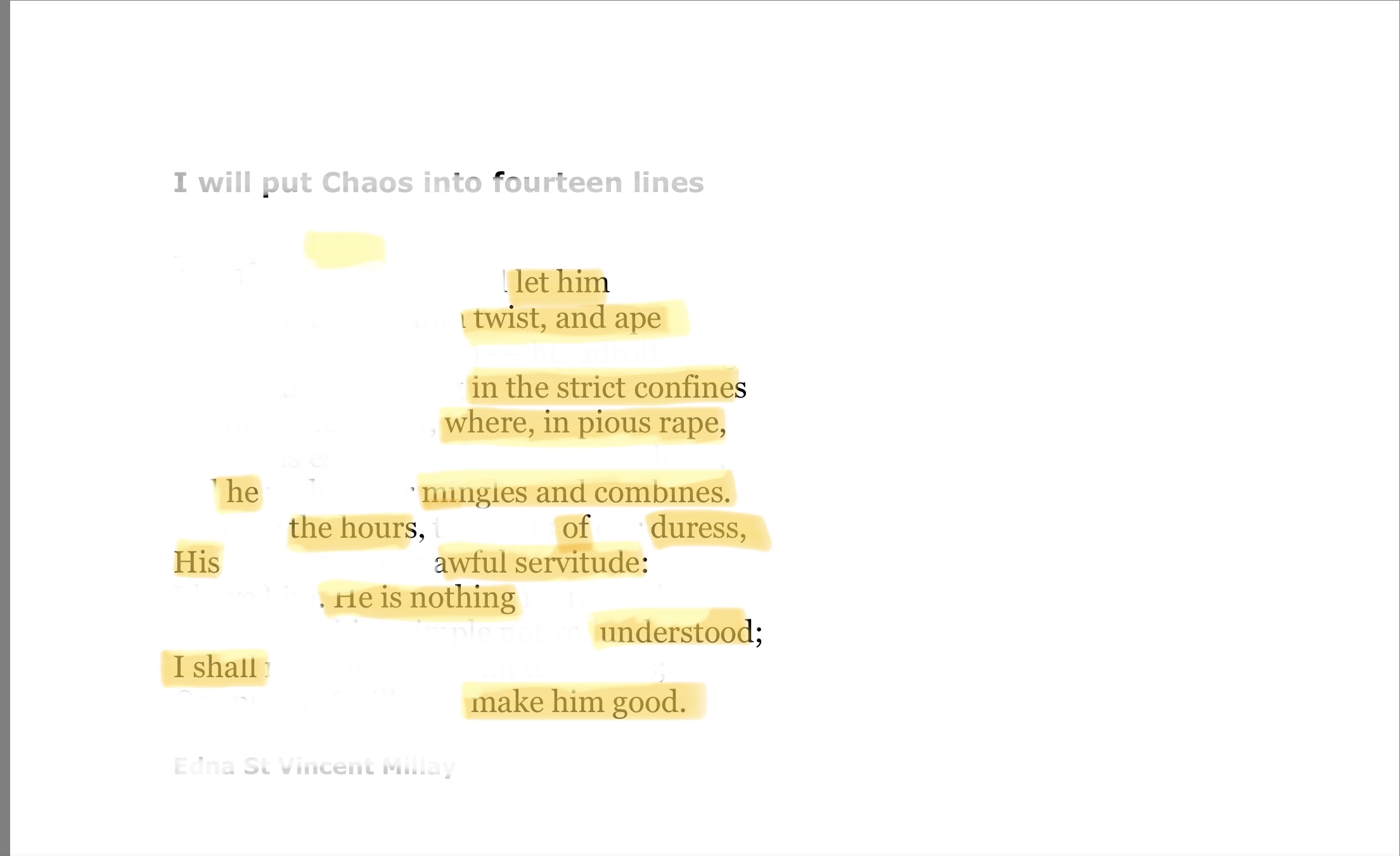
The poem by Edna St. Vincent Millay, “I Will Put Chaos into Fourteen Lines” inspired my found poem. The original work by Millay  shows several ideas, the most being a religious one. Without going too far in-depth, the poem shows a struggle with human curiousity and the power evil has on it. This poem I found upsetting because the speaker of the poem allows him/herself to feel safe around Chaos and then wanted to learn from it. This idea however allows for Chaos to continue.

I chose to modify the poem by Millay however into something different. I was inspired by both our class, as well as my American Literature class where we discussed slavery and oppression. My modifications however were not inspired by African Slavery, but Native American Slavery. Europeans originally claimed they wished to teach them Christianity. However, they did not submit freely and were brutally attacked and enslaved and used against there will in the hopes that they might convert or die. Even converting however did not end up freeing them. The Europeans saw Native Americans as savages because they did not understand them, and did not want to. My found poem was inspired by these ideas, and spoken through the voice of one of these invading Europeans.

A Raisin in the Sun, Act One

The Younger family is a melting pot of critical issues, being held together very loosely by its familial bonds. Several issues of the story thus far relate heavily to real-world issues that faced the country decades ago in the time period the text is based, but also in the world today. Conflicts of the issues mesh together, however, unfortunately, into one family, the Youngers. The country today suffers from not understanding that all the issues of today have been serious issues of the past. The text offers an opportunity for readers to observe clarity, however, the amount of clarity may be, by applying all the issues into an intriguing story of money and family matters.

The first major issue which looms over the entire family is money. Money is the great stabilizer and destabilizer in any society and family. When money becomes an issue, it penetrates each member of a family and changes everyone emotionally at some level. In the text, Ruth, the mother of Travis and wife of Walter feels the heavy burden of economic stress at multiple levels. I believe this because she attempts to keep the family in order in multiple ways. She has a job, to rake in whatever income she can while Travis is away at school, She wakes up earlier than anyone else in the house so her young son has breakfast for school, and that her son and husband are awake to be ready for the day. She attempts to brunt the burden of the economic strain on her own, since her husband is an absent drunk, except for when it comes to him wanting something from someone else. This struggle is immense on anyone on its own, however, it is enlarged immensely when she discovers she is pregnant. Incorporating the issue of barely managing to get by with one child, she now suffers, essentially alone, with the burden of deciding whether she should keep the child or sacrifice the life of an unborn for the child she has living. This is an issue that is not only present in fictional stories but common in society globally today. Whether by mistake or not, economic struggle produces immense struggle out of nowhere at times and the question of if it’s manageable;e to have a child or not, may not just be as easy as some groups would claim.

Another, strong figure in the text who has a major part in the economic situation of the Youngers is Mama. Mama is the mother of Walter, who is allowing her son’s family to stay with her. She recently lost her husband and has insurance money from his death coming. She says that she wants some of the ten-thousand-dollar check must be put away for her daughter Beneatha’s schooling. She also intends to possibly buy a better living area for the whole family, somewhere which young Travis could play in a yard and enjoy life more than in the old and dilapidated apartment the whole family currently lives in. Mama struggles with her son Walter however, who continues to use his mothers money as if it is his own. She must continuously refuse him the money because she wants the money to put the family somewhere better, whereas he wants a liquor store, which both his wife and mother do not think is a good idea, especially for a drunk. Mama struggles immensely toward the end of Act One because of Ruth’s pregnancy and attempts to get Walter to convince his wife to keep the child, however, Walter isn’t able to even talk to either of the women in the room. Although Mama attempts to keep the family on its feet financially, the issues continue to build upon an already struggling family. Many families have someone like Mama, who attempts to keep the family moving toward a better life, even with the path is long and without an end in sight. She attempts to keep their faith in a better life, especially with the potential to use the insurance money as a lifeboat to a better place. However, with Ruth now pregnant, the family is experiencing a whole new issue that they all are not prepared for.

Is the struggle against Walters plan for a Liquor Store a benefit or hindrance to the developing family struggle of the Younger’s?

Is the struggle of the pregnancy able to be remedied with the money Mama received from the insurance, or is the issues more than just money when it comes to the pregnancy?

A Single Story and it’s Affects

What makes me different than my family, my friends, my mentors? The answer is what stories I have to to distribute about my life versus what theirs are.

Humanity learns of itself through stories. Stories in textbooks, novels, bibliographies, etc. All these stories allow a separation of on person to the next. My story of my life is different from another persons. It is for that reason we are so different, despite going to the same schools, learning similar things, living in the same country. Our country however is guilty of telling a single story of groups of people, similar in some ways to how Chimamanda Adichie claims western literature  puts a label on all of Africa. Humanity has a long past of labeling, and misidentifying individuals and groups of people. Segregating people into categories is nothing new to humans today, or decades before us. For the most part, we detest the idea of such a classification system. However, not liking something and not doing something are two separate beasts. My parents don’t like texting, yet we see them texting all the time. Similarly,  we watch new media classify “Liberals” and “Conservatives” as if its a decision between one faction or another, one identity or another. Realistically however, it is completely unlikely any single, self thinking person believes wholesomely in all of one factions ideals.

Now, I am not writing to create political arguments, however I want to emphasis that we think and say things all the time that clearly divide each other in categories we all probably do not truly belong to. We often forget that people of any political party are human, they make mistakes and decisions. They are human after all. However, Adichie calls upon us all to not give into the single story, whether it be by Nigeria or by Mexico. The lesson learned should carry on into other regions of perspective as well. Whether that perspective be on how we obtain news is dependent on how far you are willing to observe to moral of Adichie’s story.

The news, globally, displays an important frame on society. As I read through the transcript of Adichie’s speech, I found a quote that speaks heavily on the worries of censored society. As Adichie says “[i]t is impossible to talk about the single story without talking about power”. This statement is completely true throughout modern human interaction with each other. Power, in all forms has the potential to corrupt. Censored media, like Russian media for example, gives one story of an incident, based completely off of what the ruling government decides. This not only gives one perspective to a potentially multi-sided story, however it allows for the government to decide the story of the people. I believe Adichie references the political implications of a single story several times throughout the speech because we are able to fight against a single story. We have the ability to go out and find the other side to the story. She wants her listeners, her readers to find the truth of each story, instead of allowing someone else to decide the story for you, or for another people. As Adichie explains in her speech, many people from her home country of Nigeria could not read because they could not afford to buy the books to read. This is an exceptionally scary issue because a people that are unable to read, are only able to listen and sometimes, listening to one perspective or what one person says is just as or even worse than knowing a single story. Ultimately, humanity as a whole must climb away from the ideas of a single story, or a single belief, in order to see the world for what it is. Yes, it is true, as Adichie admits, crime throughout the world is bad, however, crimes of the few do not make up the mind of an entire society, unless you only listen to a single story.


Questions:

After reading the texts, do you feel as though you have fallen for the single story trap?


Is it possible to end the “Single Story” problem in our lifetime, or is similar to being perfect, a constant attempt but never getting to perfection?

Brian Poerio

This will be my junior year in college, however, I am a new transfer from SUNY Suffolk. Suffolk is a community college I attended following graduating early from high school.  I am immensely entertained by literature and how it could affect culture, thoughts, and add perspective to a situation once thought to only be two dimensional. I am a certified Search and Rescue Instructor on Long Island. However, the certification carries throughout all U.S. territories should it be needed elsewhere. My personal favorite novel/movie is To Kill a Mockingbird. The story, at the core, is a journey of innocence but I feel the story also dips into aspects of what it means to be American. What I mean by this is that the values of an American should be held equal throughout, simply based on the foundation and premise the countries roots were found upon. However the story shows several perspectives of America through three key characters (Society, Scout, and Atticus) and these characters are able to intertwine with the theme of innocence, but also mix in other themes if the story is seen through that lens.

css.php